
The Backup Plan Is Burning
The widening war is exposing how little slack remains in the global economy. Every route around the crisis is becoming another part of the crisis.

AFTER GROWTH A newsletter for the world that’s coming
Issue #1 — July 31, 2026
Last Saturday, Houthi forces fired missiles and drones at Saudi oil facilities in Jizan and Yanbu, two cities on the kingdom’s Red Sea coast. The attacks marked the first claimed Houthi strikes on Saudi oil infrastructure since 2022 and extended a war already straining the Persian Gulf into another of the world’s critical energy corridors.
Yanbu was the more consequential target.
For years, Saudi Arabia’s East-West Pipeline offered an answer to one of the global energy system’s most obvious vulnerabilities. Most Saudi oil fields lie east of the country, close to the Persian Gulf. Ordinarily, much of that crude leaves through the Strait of Hormuz, the narrow waterway between Iran and Oman through which a significant share of the world’s oil supply must pass.
When shipping through Hormuz became dangerous, Saudi Arabia could send some of its crude hundreds of miles across the desert to Yanbu, bypassing the strait and loading it onto tankers in the Red Sea.
That route was supposed to provide redundancy. It was the alternative when the obvious chokepoint became unusable.
Then the alternative came under attack.
Two days later, the Houthis said they had also targeted sites along the pipeline and transport network connecting Saudi Arabia’s eastern oil fields to Yanbu. Saudi Aramco did not immediately confirm the extent of any damage, but the choice of targets was clear enough: the workaround itself had become strategically valuable, and therefore vulnerable.
The conflict was spreading elsewhere as well.
Iran fired ballistic missiles at military facilities in Jordan, where American forces are stationed. Jordanian defenses intercepted a number of them, although earlier attacks during the month killed two U.S. military personnel, according to the U.S. military.
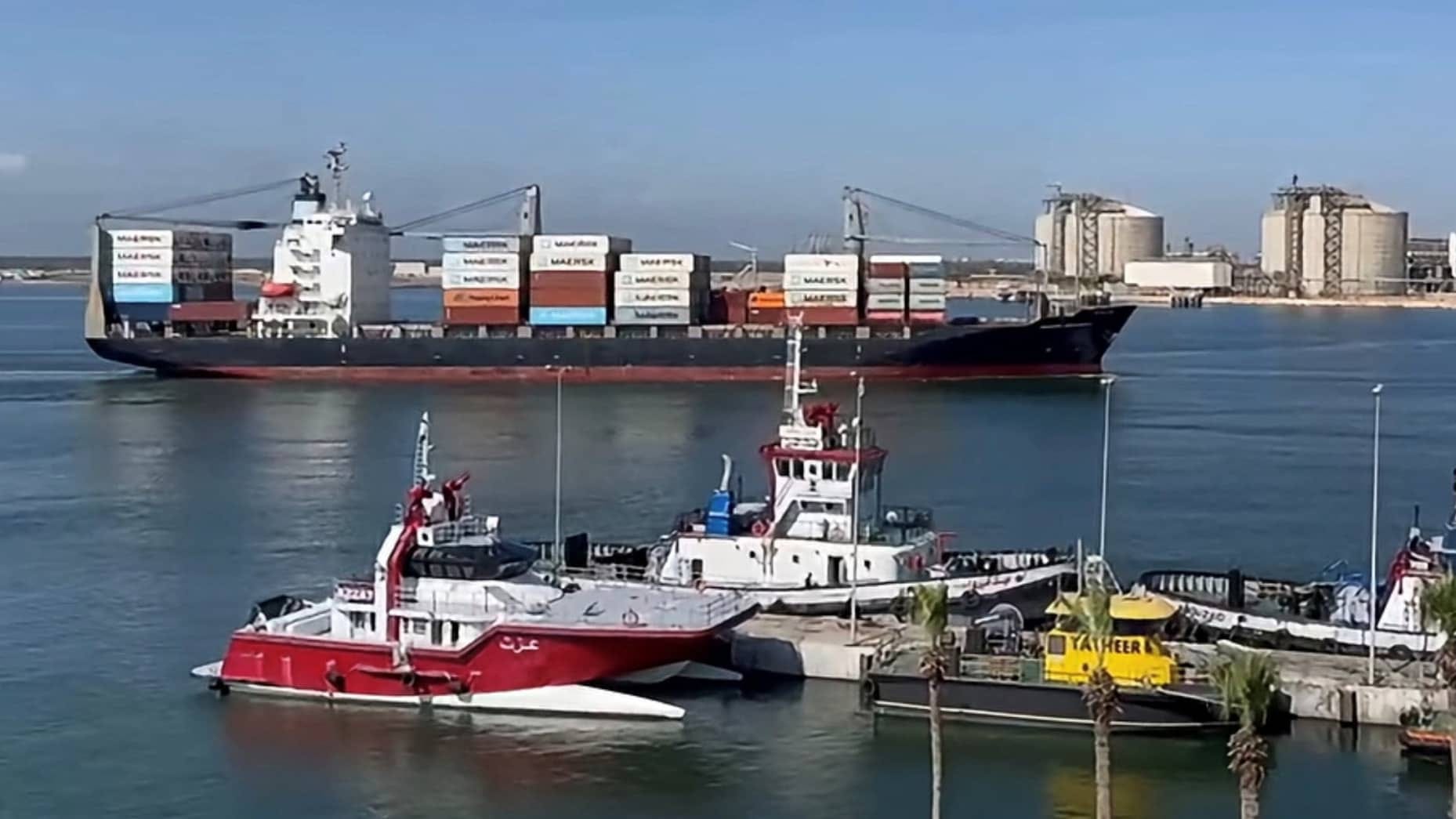
In Egypt, a drone struck vessels at the port of Damietta, igniting a fire aboard gas ships near the Suez Canal. One of the damaged vessels was identified as a U.S.-owned gas-storage tanker. Egypt said the drone was unidentified, so responsibility should not be stated as settled fact, but the attack brought another major shipping and energy hub into the conflict’s widening geography.
Saudi Arabia. Jordan. Egypt. The Strait of Hormuz. The Red Sea. The Suez Canal.
The map now matters as much as the individual attacks.
The global economy has spent months trying to route around war. Oil moved away from Hormuz and toward Yanbu. Ships sought safer waters. Military logistics shifted through allied countries. Gas infrastructure in Egypt gained importance as other routes became less dependable.
Each adjustment kept the system functioning.
Each adjustment also concentrated more importance in the places still working.
That is the uncomfortable logic of the moment: every route around the crisis is becoming another part of the crisis.
The Workaround Becomes the Target
Modern supply chains are often described as networks, which makes them sound flexible. A network suggests multiple routes, countless connections and the ability to move smoothly around damage.
Sometimes that is true. Networks can be remarkably adaptive.
But adaptation has consequences.
When one route closes, traffic moves to another. The second route becomes more crowded, more economically important and more politically sensitive. Infrastructure designed as a backup begins carrying the weight of the primary system. Its value rises. So does the damage an adversary can cause by disrupting it.
The vulnerability has not disappeared. It has moved.
We have seen this pattern repeatedly. European countries reduced their dependence on Russian pipeline gas and became more reliant on liquefied natural gas delivered by ship. Companies shifted manufacturing away from China and discovered new dependencies in Vietnam, Mexico and India. Drought limited passage through the Panama Canal, pushing more freight toward other ports and routes that were already under strain.
Resilience is usually discussed as though it means having a second option. In practice, the second option must have spare capacity, maintenance, trained workers, secure access and enough independence that it will not fail for the same reason as the first.
Otherwise, redundancy exists mostly on paper.
Yanbu was not an obscure facility suddenly dragged into a distant war. Its importance grew precisely because the global energy system needed somewhere else to go.
The same is true of Jordan and Egypt. Jordan hosts military infrastructure partly because it has long been treated as a relatively stable partner in a volatile region. Egypt’s ports, pipelines and canal matter because they connect the Mediterranean, the Red Sea and global energy markets. Stability made these places useful. Their usefulness made them strategically significant.
This is how a regional conflict becomes a systems crisis. The fighting does not need to destroy the entire network. It only needs to keep placing pressure on the shrinking number of routes the network still trusts.
How a Missile Reaches the Grocery Store
The effects of these attacks will not remain in the Middle East.
They rarely arrive in American households under the heading “geopolitics.” They arrive as fuel surcharges, utility bills, insurance premiums and a grocery receipt that seems to rise every week even when inflation is supposedly moderating.
Oil is most visible at the gasoline pump, but transportation is only the beginning. Diesel powers tractors, combines, trucks, freight trains and much of the machinery used to mine, manufacture and build. Petrochemicals are embedded in plastics, packaging, pharmaceuticals and thousands of industrial products.
Natural gas is a central feedstock in nitrogen fertilizer. When energy becomes scarce or expensive, fertilizer production can fall while its price rises. Farmers then face a series of choices, none of them especially good: absorb the cost, plant less, use less fertilizer or pass higher expenses through the food system.
Those costs move slowly.
A missile is launched in July. A fertilizer contract changes in August. A farmer revises planting plans months later. A food processor pays more after the harvest. A supermarket adjusts prices after that.
By the time the household feels the shock, the original event has disappeared from the story.
This delay makes interconnected crises difficult to perceive. Human attention is drawn to visible impact: the explosion, the fire, the intercepted missile. Economic systems often transmit damage through quieter mechanisms—contracts, inventories, credit, expectations and the gradual repricing of risk.
A family in Ohio does not need to understand the East-West Pipeline to experience its vulnerability. The relationship appears in the price of food transported by truck, grown with fertilizer made from natural gas and packaged in materials derived from petroleum.
The distance between Yanbu and an American grocery aisle is enormous.
Economically, it is much smaller.
The Reserves We Mistook for Waste
For decades, efficiency was treated as an almost unqualified good.
Warehouses full of inventory looked wasteful. Multiple suppliers looked unnecessarily expensive. Local production struggled to compete with vast factories operating at greater scale. Hospitals cut spare beds. Companies reduced staffing. Municipal governments deferred maintenance. Railroads ran longer trains with fewer workers. Manufacturers adopted just-in-time production so that parts arrived shortly before they were needed.
Every decision had a rationale. Many delivered real benefits. Goods became cheaper. Capital moved faster. Companies increased output while holding fewer resources in reserve.
The difficulty is that reserves are only wasteful until they are needed.
A spare hospital bed looks inefficient on an ordinary Tuesday. A second supplier appears redundant until the first one shuts down. A regional grain mill costs more per unit than a centralized processor, right up to the moment the highway closes or the distant plant loses power.
Efficiency asks how little a system can carry while continuing to function under normal conditions.
Resilience asks what happens when conditions stop being normal.
We have spent much of the past half-century pursuing the first question while assuming somebody else was taking care of the second.
Often, nobody was.
The result is a global economy capable of producing astonishing abundance under stable conditions and surprisingly poor at absorbing prolonged disruption. It can move millions of products across continents with exquisite precision, yet struggle when a single component is unavailable. It can deliver next-day packages to individual doorsteps while leaving entire communities dependent on one distant food distributor, one hospital system or one insurance provider.
This arrangement did not emerge because everyone involved was foolish. It emerged because the rewards for efficiency are immediate and measurable, while the value of resilience remains hypothetical until a crisis arrives.
A company can calculate the savings from closing a warehouse. It cannot easily place a quarterly value on the disruption that warehouse might have prevented five years later.
The market records the cost of redundancy.
It has far more trouble recording the cost of fragility.
The Future Was Supposed to Pay for Everything
Beneath this pursuit of efficiency lies a deeper expectation: tomorrow’s economy will be larger than today’s.
Growth allows debts to be repaid from future income. It raises the value of investments. It supports pensions and tax revenues. It gives companies room to increase profits without openly taking more from workers, customers or communities. It allows political leaders to promise that competing interests can all receive more without having to argue too directly about distribution.
So long as the economy keeps expanding, many conflicts can be postponed.
When growth becomes slower, more expensive or ecologically destructive, those conflicts return.
Companies still face demands for higher returns. Governments still carry debts based on assumptions about future revenue. Households still need wages to outrun housing, medical and education costs. Pension funds still require investment gains. Public institutions still need expanding tax bases to maintain systems built during periods of cheaper energy and younger populations.
The pressure does not disappear when the underlying conditions change. It moves downward and outward.
Maintenance is deferred. Staff are cut. Fees rise. Services are consolidated. Local businesses are acquired by larger firms. Public assets are sold. Housing becomes an investment vehicle. Hospitals close units that do not produce sufficient margins. Insurers leave communities where the risk no longer fits their models.
It is tempting to explain all of this as greed, and greed certainly exists. But focusing exclusively on individual motives lets the structure escape examination.
A hospital administrator may care deeply about patients and still close a maternity ward because the numbers no longer work. A farmer may care about the soil and still take on debt to buy larger machinery because the surrounding agricultural economy rewards scale. A CEO may understand that layoffs will damage a town and still approve them because the company is judged against competitors willing to do the same.
People make choices. Institutions shape which choices remain available and which are punished.
That distinction matters because moral condemnation is a poor substitute for structural understanding. Telling people to behave better inside systems that penalize better behavior may produce admirable exceptions. It rarely changes the prevailing outcome.
Where the Surplus Goes
One question helps cut through a great deal of economic abstraction:
When an institution creates a surplus, where does it go?
Consider two towns.
In the first, residents buy groceries from a locally owned store. The store purchases from nearby farms when possible. Its owners live in town, deposit money at a regional bank and hire local tradespeople. Employees spend part of their wages at other nearby businesses. The same dollar may move through the community several times before leaving.
In the second town, the grocery store belongs to a national chain. The apartments are owned by a private investment fund. The bank is headquartered across the country. The pharmacy, hardware store and nursing home answer to distant shareholders.
Residents in both towns work, shop and pay rent.
But the movement of money is different.
In one place, some portion of the wealth created locally remains available for local lending, wages, taxes, maintenance and reinvestment. In the other, more of it exits through rent payments, corporate profits, management fees, debt service and shareholder distributions.
Both communities may look prosperous during good times. They may have the same brands, similar household incomes and nearly identical retail developments.
Their ability to respond to disruption can be radically different.
A community cannot use wealth that has already left. It cannot ask an absentee landlord to accept a lower return because the local economy is struggling. It cannot easily persuade a national bank to preserve a marginal branch or a corporate hospital chain to maintain an unprofitable service.
Local ownership does not guarantee virtue. Cooperatives can be badly managed. Credit unions can fail. Small businesses can underpay workers, and local elites can be every bit as extractive as distant ones.
Still, the location of ownership changes the arena in which decisions are made. It determines who has standing, who receives information, who can exert pressure and whether the consequences of a decision are visible to the people making it.
During periods of stability, these distinctions can look sentimental.
During periods of disruption, they become practical.
What Communities Do Under Pressure
When the Soviet Union collapsed, Cuba lost most of the oil, fertilizer, pesticides and trade on which its industrial agricultural system depended.
The resulting “Special Period” was severe. Food intake fell. Transportation systems faltered. Blackouts became common. The suffering should not be polished into a comforting story about urban gardening.
Yet Cuba’s response still deserves attention because it revealed what becomes possible when centralized systems can no longer provide at the previous scale.
Vacant urban land was converted into gardens. Farmers shifted toward less fuel-intensive methods. Oxen returned to fields where tractors could no longer run reliably. Agricultural knowledge moved through neighborhoods and local institutions. Food production became more decentralized because the older model had lost the inputs required to sustain it.
The state played a large role, as did existing public institutions, but much of the adaptation depended on relationships, practical knowledge and the ability to organize close to where the problem was being experienced.
Greece offered another version after the financial crisis and the austerity that followed. As unemployment surged and public services were cut, communities formed solidarity clinics, food networks, social pharmacies and cooperatives. These organizations did not make austerity benign, nor did they compensate fully for weakened public institutions. They helped keep people alive and connected while those institutions failed to meet the need.
The useful lesson is not that communities can replace everything governments and markets once provided.
They cannot.
The lesson is that communities with habits of cooperation possess options that isolated households do not.
A garden created after the food system breaks will not produce immediately. A lending circle formed after credit disappears begins without trust. A neighborhood trying to organize during an emergency must first discover who has tools, medical knowledge, transportation, storage space or time.
Capacity built before a crisis can be used during one.
Capacity imagined during a crisis may arrive too late.
Building Before the Emergency
This is where the discussion of systems can become either useful or paralyzing.
The scale of the problem invites grand responses: national industrial policy, redesigned trade systems, public banking, energy transition, land reform and a different relationship between economic life and the physical limits of the planet.
Those questions matter, and this newsletter will return to them.
Most of us also live in particular places, use particular institutions and make recurring decisions about where our money, labor and attention go. Those decisions will not dismantle an extractive economy one household at a time. They can strengthen the institutions we may depend on as larger systems become less reliable.
So each issue of After Growth will end with one practical place to build.
This week, find the federally insured credit unions serving your ZIP code. Compare their checking fees, savings rates, branch access, lending practices and eligibility requirements. Look at how the institution is governed, whether members can vote, and whether it lends to local households and businesses.
Then choose one and open an account, even if you begin with savings rather than moving your entire financial life at once.
A credit union is owned by its members rather than outside shareholders. That does not automatically make every credit union equitable, well managed or responsive to its community. It does, however, change the basic direction of the institution. Surplus is generally retained as reserves, returned through lower fees or better rates, or used to support additional lending.
The immediate benefit is practical: you learn how the institution works before you urgently need an alternative. The broader value is structural. Deposits become lending capacity inside a member-owned institution rather than another source of return for distant shareholders.
Moving an account can feel almost comically small beside ballistic missiles, shipping corridors and global energy markets. But scale can obscure the question that matters most: do the institutions receiving our money increase the capacity of the places where we live, or steadily drain it away?
A community with deposits, lending relationships and accountable financial institutions has more room to respond when larger systems become unreliable. A community whose financial life is controlled almost entirely elsewhere has fewer options.
The institution holding your money is part of the economy you are helping to sustain. Choose accordingly.
After Growth Has Already Begun
We tend to imagine historical transitions as visible breaks: the market crashes, the government falls, the power goes out, the old era ends and another begins.
Most transitions are less considerate.
They arrive unevenly. One family loses access to affordable insurance. One town loses its hospital. One farmer can no longer afford fertilizer. One renter watches another apartment building pass into the hands of an investment fund. One shipping route becomes too dangerous, so commerce moves to another route that soon becomes dangerous in turn.
Life continues. The systems still function, although less consistently and at greater cost. Those with money purchase alternatives. Everyone else absorbs more risk.
No announcement tells us that the underlying rules have changed.
The attacks in Saudi Arabia, Jordan and Egypt do not prove that the global economy is about to collapse. They reveal something more immediate: the margins of safety are narrowing. Places valued for their stability are being drawn into the conflict because the system increasingly relies on them. Backup routes are becoming primary routes, and primary routes are becoming targets.
The old answer to disruption was expansion. Find another supplier. Open another market. Build another pipeline. Borrow against future growth. Move the cost somewhere less visible.
There are fewer empty spaces left in which to hide those costs.
That leaves us with the work that expansion allowed us to postpone: deciding what must be protected, what should be produced closer to home, which institutions deserve our participation and where wealth should remain after it is created.
The transition after growth is not waiting somewhere beyond the next recession or the next war. It is already taking shape in the distance between systems that continue to promise security and communities increasingly required to provide it for themselves.
We should pay attention to the missiles.
We should pay even closer attention to what they reveal about the world they are landing in.
Next week we’ll look at an institution that’s quietly becoming one of the clearest indicators of the future: insurance.
Insurance companies don’t argue about climate change. They price risk. And increasingly, they’re deciding that entire communities are no longer worth insuring.
Those decisions are reshaping housing markets, local tax bases, mortgages, and municipal budgets long before most people notice.
Until then, pay attention to the systems behind the headlines.
Fantastic write up. Saving this one for future reference when discussing the fragility of our global economy.
At some point people are going to wake up to the fact that all of this is a horrific stage production, with terrible actors, and the citizens are unwitting extras in this loathsome movie with real consequences.
The politicians and bureaucrats are all bought, blackmailed, and bribed and reading literal scripts, and as the show gets deliberately more ludicrous and outrageous (demoralizing mentacide), so does their digital ID, 15 minute CBDC prison get closer to reality.
One morning you'll wake up to find they are:
"taking down the scenery, pulling back the curtains, moving the tables and chairs out of the way and showing you the brick wall at the back of the theater.” -Zappa
We have to act to save ourselves, because no one is coming to our rescue. Here is how: We first need to build a platform of local strength, self-reliance, and resiliency. Once done, and we have a solid foundation from which to stand, from there we begin working on taking back the higher levels: county, state, federal.
The following solutions were crowdsouced from various forums across the web. I have distilled them into this:
The solution is to get local, get self-reliant, get the common unity back in community by building webs of resilience with your neighbors, get control of your school boards, mayors and sheriff's office, and town councils (the last places we still hold all of the cards), get a garden in your lawn no matter how small, a single tomato plant is better than nothing, get a well (water is your most important resource hands down), get ready, get moving, get doing, and, if so inclined, get God.
Everyone is looking for a savior instead of looking in the mirror. We are the ones we've been waiting for